


What Is the Psoas Muscle?
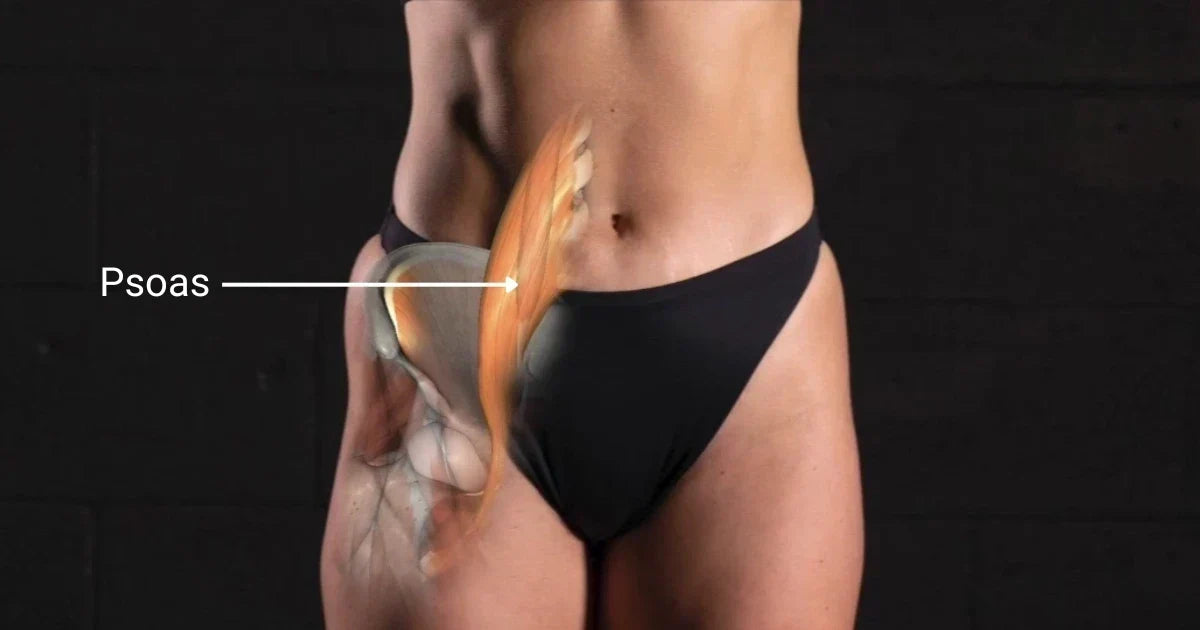
The psoas muscle is a long, deep hip flexor that runs from your lower spine below the level of your ribs down through your abdomen, to finally attach at the top of your inner thigh bone. This means it travels from the back of your body to the front of it. The psoas is one of the only muscles in your body that connects your spine directly to your leg, which means every step, every time you sit up, and every time you flex your hip, your psoas is involved, and so is your lower back.
The psoas also acts as a stabilizer of the lumbar spine, working alongside your deep core to control your lower back position during movement. When it holds chronic tension, it does not just limit hip motion. It pulls directly on your lumbar vertebrae, too, which can drive pain in places that have nothing obviously to do with the hip.
Where Is the Psoas Muscle?
The psoas major originates from two places at once: the bodies of your lumbar vertebrae and the discs between them, and the transverse processes, the small bony projections that branch off each vertebra. It originates roughly from T12 down through L5, then travels down through your pelvis, in front of the hip joint, and joins with the iliacus to form the iliopsoas tendon before inserting onto the lesser trochanter of your femur, the same insertion point the iliacus shares.
That shared insertion is where the similarity with the iliacus ends. The iliacus originates entirely on the inner surface of your pelvis. The psoas originates directly on your spine. That difference matters enormously, because it means tension in the psoas has a direct line to your lumbar vertebrae, whereas iliacus tension indirectly affects the lower back by tugging on the pelvis.
READ MORE: What Is the Iliacus Muscle?
What Does the Psoas Muscle Do?
Functionally, the psoas flexes the hip, assists with external rotation of the thigh, and when your leg is fixed in place, helps flex your trunk forward. It also doubles as a spinal stabilizer, contracting alongside the deep core to control the lower back during movement of your arms, legs, and trunk. The lumbar plexus, the network of nerves supplying much of your hip, groin, and inner thigh, runs directly through the psoas. This is one reason why psoas tightness can produce sensations that feel neurological even when the muscle itself is the source.
That also matters because psoas tension is common. Prolonged sitting keeps the hip flexed, keeping the psoas in a shortened position for hours at a time. On top of that, chronic stress, repetitive movement patterns, and even poor sleep compound that tension. Because most conventional approaches, like standard hip flexor stretches and foam rolling, don't address resting tension directly, it tends to accumulate quietly over time.
What Happens When the Psoas Holds Tension?
Because the psoas attaches directly onto your lumbar vertebrae at multiple levels, chronic tightness pulls those vertebrae forward and downward with every contraction, increasing lumbar lordosis, the natural curve of your lower back, beyond what is comfortable or stable. A 2023 study published in the Journal of Back and Musculoskeletal Rehabilitation found a meaningful relationship between lumbar lordosis and the shape and behavior of the psoas major during sustained postural loading. That increased curve compresses the lower spinal joints and discs directly, often before any pain shows up in the hip at all.
When the tightness is uneven side to side, which it usually is, the pull becomes rotational as well as compressive, twisting the lumbar spine slightly with every step. This is part of why psoas-related back pain often feels deep, one-sided, and resistant to standard core exercises. The muscle creating the imbalance is rarely the muscle being targeted.
Like the iliacus, a chronically tight psoas contributes to reciprocal inhibition of the glutes, and it tends to overload the same secondary muscles, like the piriformis and the quadratus lumborum, that pick up stabilization work that these areas should be sharing. The psoas is also one of the muscles most consistently described as reactive to psychological stress: it sits close to the diaphragm and tends to brace along with the rest of the body's fight-or-flight response. That does not mean every tight psoas is stress-related, but it is a contributing factor worth considering alongside posture and activity.
How to Reduce Psoas Muscle Tightness?
Stretching helps the psoas move through a longer range, but it does not lower the muscle's resting tension the way sustained pressure does. The technique that works is the same one used for the iliacus: pressure held directly on the muscle for 90 seconds or more, which triggers the nervous system to reduce the muscle's baseline activation. Physical therapists call this ischemic compression.
The difference is how you access each of the hip flexor muscles. The iliacus sits inside the pelvic bone, so you have to curve around the bone to reach it. The psoas sits deeper in the abdomen, closer to the spine. To find it, press a couple of inches inside the pelvic bone and angle your pressure downward and toward the center of the body. Because the femoral artery, femoral nerve, and abdominal organs sit nearby, gentle rather than heavy pressure is recommended here.
Steps to Address Psoas Tension
- Test your range of motion. Lie face down, or stand and step one leg back into a gentle lunge, and notice how far your hip extends before you feel a pull at the front of your hip or a pinch in your lower back. Note where that boundary is on each side so you can compare after releasing.
- Locate the psoas. Lying on your back with your knees bent, find the soft area a couple of inches inside your hip bone, roughly level with your navel. Press in gently and slowly, angling your pressure downward and toward the center of your body, until you feel a dense, tender band.
- Apply sustained, gentle pressure. Go slowly; the psoas does not respond well to heavy pressure. A pulsing sensation means you are on or near an artery and need to reposition. Once you find a tender, non-pulsing spot, hold light to moderate pressure for 90 seconds. A tool designed for this angle makes it significantly easier to maintain consistent contact without pressing too hard.
- Release, then retest. Compare your hip extension or lunge depth on both sides. A noticeable easing in tightness or an increase in range confirms you released the right area.
- Repeat consistently. Psoas tension that has built up over months or years will not resolve in one session. Daily or near-daily work produces the most lasting change.
- Reactivate and strengthen. Once the psoas has released, glute activation and deep core stability work will hold better, since those muscles are no longer working against a spine being pulled out of position from the front.
- Address contributing habits. Prolonged sitting, running with a shortened stride, and chronic stress bracing all reload psoas tension. Addressing these alongside release work reduces how quickly the tension returns.
READ MORE: Understanding and Managing Hip Flexor Pain
When to See a Professional for Psoas Tightness
Psoas tension is common and often addressable at home, but because of what sits near this muscle, a few presentations should always be evaluated by a clinician before self-treating.
- Numbness, tingling, or weakness radiating into the groin, inner thigh, or leg
- Sharp abdominal or lower right- or left-sided pain, fever, or nausea, which need to be evaluated for causes unrelated to muscle tension, including appendicitis
- Groin or abdominal pain accompanied by a visible bulge (possible hernia)
- Pain following a fall, accident, or injury
- Pain during pregnancy, or in the weeks following abdominal or pelvic surgery
- Pain that does not improve after two to three weeks of consistent, gentle self care
What Is the Best Tool for Psoas Tightness?

The Orbit is a great starting point for releasing the psoas. Its size and density allow it to get deep enough to reach the muscle, while its broad, contoured surface is gentle enough to let you ease into the intensity of the release. For many people, starting with the Orbit helps the muscle relax before moving to more precise myofascial release work.
The Hip Hook takes it one step further. When its tip is angled straight up, it targets the psoas directly with more precision. And because it's designed to curve around the pelvic bone, it can also reach the iliacus, the other half of the iliopsoas complex, which should be released alongside the psoas for the best results in reducing overall hip flexor tightness.
Both tools apply the sustained pressure principle validated in Aletha's randomized controlled trial: in a study of 25 participants with chronic low back pain, users reported a 27% reduction in pain and a 24% reduction in muscle tension after just one 90-second session with the Hip Hook. Results may vary.
LEARN MORE: Discover the Hip Hook and Orbit
Key Takeaways
- The psoas is a deep hip flexor that originates on the lumbar vertebrae, T12 through L5, and inserts on the lesser trochanter of the femur alongside the iliacus.
- Unlike the iliacus, which originates entirely within the pelvis, the psoas attaches directly to the spine, giving chronic tension a direct line to the lumbar vertebrae.
- Tight psoas muscles increase lumbar lordosis and can compress the lower spinal joints and discs, often before hip pain shows up at all.
- The psoas contributes to reciprocal inhibition of the glutes and often reacts to psychological stress alongside posture and activity.
- Releasing the psoas requires gentle, sustained pressure at a precise angle. Heavy pressure or a pulsing sensation signals you are too close to an artery.
- Red flags including a pulsing sensation, radiating numbness, abdominal pain and fever, or pain after injury warrant evaluation by a clinician before self-treating.
Frequently Asked Questions
What is the difference between the psoas and the iliacus?
Both are deep hip flexors that merge into the iliopsoas tendon before attaching to the femur, but they originate in different places. The psoas originates from the lumbar vertebrae and passes through the abdomen, giving it a direct connection to the spine. The iliacus originates entirely within the pelvis, on the iliac fossa. Because of that difference, tension in each muscle affects the body differently and each requires a different angle of access to release effectively.
Where exactly is the psoas muscle located?
The psoas sits along your lower spine and travels down through your abdomen and pelvis, in front of the hip joint. To find it, lie on your back with your knees bent and press gently a couple of inches inside your hip bone, angling your pressure downward and toward the center of your body. You are feeling for a dense, tender band, not a hard bony landmark.
Can a tight psoas cause low back pain?
Yes. Because the psoas attaches directly to the lumbar vertebrae, chronic tightness increases lumbar lordosis and can compress the lower spinal joints and discs. Low back pain has many possible causes, and a clinician can help determine whether the psoas is a contributing factor in your case.
Does stretching release the psoas?
No. Stretching can improve how far the psoas lengthens, but it does not lower the muscle's resting tension, or the baseline level of contraction the muscle holds even at rest. Releasing the psoas effectively requires gentle, sustained pressure held for about 90 seconds, which signals the nervous system to reduce that baseline activation. Stretching alone cannot produce this effect.
Is it safe to apply pressure to the psoas myself?
For most people, yes, with care. Because the psoas sits close to the femoral artery, femoral nerve, and abdominal organs, pressure should always be gentle. If you are pregnant, have had recent abdominal or pelvic surgery, or have any of the red flag symptoms described in this article, check with a clinician before self-treating.
How do I know if my psoas is tight?
The most common signs of a tight psoas are a pulling or aching sensation at the front of the hip or groin during hip extension, low back pain that worsens after prolonged sitting or increases when your lower back arches, and difficulty fully extending the hip during a lunge or standing stretch. Asymmetries are also telling: one hip that feels consistently tighter, one side of the low back that aches more, or a pelvis that feels rotated are all patterns that often point to uneven psoas tension.
Can a tight psoas cause sciatica?
A tight psoas does not compress the sciatic nerve directly, but it can produce symptoms that feel similar. A tight psoas can also indirectly affect the sciatic nerve: by contributing to reciprocal inhibition of the glutes, it tends to overload the piriformis, a deep hip rotator that sits close to the sciatic nerve. When the piriformis is overloaded and tight, it can compress or irritate the nerve.
References
- Andersson EA, Nilsson J, Thorstensson A. Intramuscular EMG from the hip flexor muscles during human locomotion. Acta Physiologica Scandinavica. 1997;161(3):361–370. https://doi.org/10.1046/j.1365-201X.1997.00225.x
- Sajko S, Stuber K. Psoas major: a case report and review of its anatomy, biomechanics, and clinical implications. Journal of the Canadian Chiropractic Association. 2009;53(4):311–318. https://www.ncbi.nlm.nih.gov/pmc/articles/PMC2796944/
- Liu Y, Hao J, Du M, Hu S. Psoas major and lumbar lordosis may correlate with pain episodes during Sorensen test in patients with non-specific low back pain. Journal of Back and Musculoskeletal Rehabilitation. 2023.
- Reiner S. Aletha Health: Revolutionizing therapeutic strategies for back pain and physical performance [White paper]. Aletha Health. 2025. https://alethahealth.com/pages/white-paper


If you’ve tried PT, massage, stretching, and the pain keeps coming back, the problem is likely not where you’re feeli...
- HSA/FSA eligible
- 60-day returns
- Free shipping
If you’ve tried PT, massage, stretching, and the pain keeps coming back, the problem is likely no...