


Anterior Pelvic Tilt: What Causes It and How to Fix It
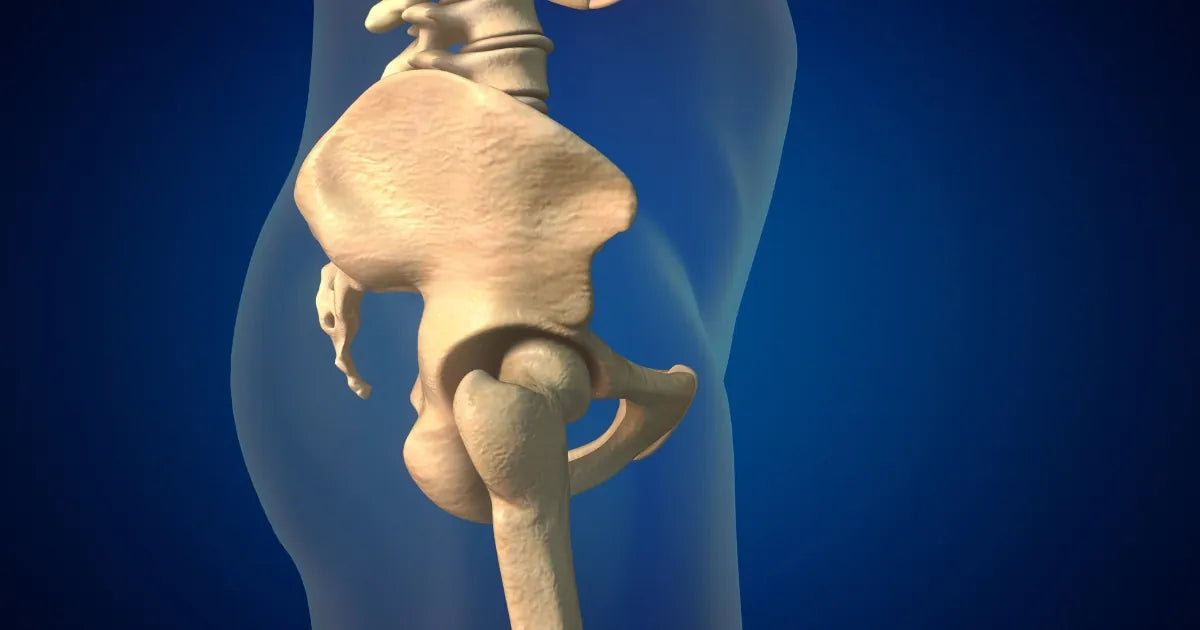
Anterior pelvic tilt is a forward rotation of the pelvis that loads the lower back, SI joint, and hips in ways the body was not designed to sustain for long. It gets blamed on posture, weak abs, and sitting too much at a desk, and all of those play a role. But from what I've seen in clinic, the muscle actually driving the tilt is almost always the iliacus, the deep hip flexor that lines the inside of the pelvis. Below, I'll walk through what anterior pelvic tilt actually is, why the hip flexor is usually the primary driver, what it feels like in the body, and the sequence I use to correct it.
What is anterior pelvic tilt?
Anterior pelvic tilt is a forward rotation of the pelvis that increases the natural curve in the lower back, a posture pattern sometimes described as an exaggerated arch or a duck stance.1 In a neutral pelvis, there is already a small forward tilt and a healthy curve in the lumbar spine. It is that same tilt taken further than normal, to the point where it starts loading the spine, the SI joint, and the hip differently than a neutral position would.
What causes anterior pelvic tilt?
The primary driver in most cases is chronic tightness in the hip flexors, specifically the iliacus and psoas, which together are known as the iliopsoas complex.2 When these muscles shorten from prolonged sitting, repetitive hip flexion in sport, or simply years of holding the hip in a shortened position at rest, they pull the front of the pelvis downward and forward. Weak glutes and abdominals make the tilt worse and harder to hold in a corrected position, but they are rarely the original cause. A person can strengthen their core for months and still hold an anterior tilt if the hip flexor pulling it forward is never addressed.

Why do the hip flexors get so tight?
The hip flexors get tight because they shorten every time you sit, and most people never give them a sustained opportunity to fully lengthen and release that accumulated tension. The iliacus and psoas are hip flexors, meaning their job is to bring the thigh toward the torso. Every time you sprint, cycle, do squats, or perform repeated hip flexion in sport, they contract and shorten again on top of that.
Prolonged sitting is the most common culprit in clinic. Eight or more hours at a desk, followed by a workout that involves more hip flexion, and the hip flexors never fully decompress. Over time, they begin to hold a partial contraction even at rest. That resting tension is what pulls the pelvis forward into a tilt.
Will strengthening your glutes and core fix anterior pelvic tilt?
The glutes and abdominals are the muscles that oppose the hip flexor pull. Strong glutes posteriorly tilt the pelvis; a strong core provides the stability to hold a neutral position. When both are weak, the body has no counterbalance to the forward pull of tight hip flexors.
This is where the conventional advice to "strengthen your glutes and core" comes from, and that advice is not wrong. It simply addresses the wrong end of the problem first. Strengthening muscles that are fighting against an unrelenting tension in the hip flexors is an uphill battle. The tension has to be released before the strength work can actually take hold.
What Are the Signs and Symptoms of Anterior Pelvic Tilt?
The most recognizable sign of anterior pelvic tilt is an exaggerated inward curve in the lower back when standing relaxed, with the pelvis visibly tipped forward from the side. The butt appears to stick out, and the lower abdomen may have a slight protrusion, even in people who are not carrying extra weight.
Other common signs include:
- Hip flexors that feel pulled or tight even at rest
- A lower back that fatigues quickly with standing
- Glutes that feel underactive or difficult to engage during exercise
- Hamstrings that are persistently "tight" despite regular stretching
- Tightness or aching in the front of the hip or groin area
- Lower back, SI joint, or hip pain that does not have a clear injury explanation
The pain pattern with anterior pelvic tilt is often diffuse. People feel it in the lower back, the hips, and sometimes down the legs, which makes it easy to misattribute to other causes.
How to Check for Anterior Pelvic Tilt at Home
There are two things you are checking for: whether both sides of the pelvis are tilting forward together, and whether one side is rotating more than the other.
To check for an overall forward tilt, stand relaxed in front of a mirror in profile. If your lower back has an exaggerated inward curve and your pelvis looks like it is tipping your belly forward and your tailbone backward, anterior pelvic tilt is likely present. You can also lie flat on your back on a firm surface and notice the space between your lower back and the floor. There should be a small, neutral curve there. If the gap is pronounced, that points to an anterior tilt on both sides.
To check for asymmetry, meaning one side rotating more than the other, use the supine-to-sit test. Lie flat on your back with your legs straight and have someone note the relative length of your legs. Then sit up to a long-sitting position (legs still straight out in front) and notice again. If one leg appears to shorten as you move from lying to sitting, that points to the pelvis rotating more on that side, typically from tightness in the iliacus on that side.
LEARN MORE: Try the Supine to Sit Test
Does a more exaggerated pelvic tilt cause more serious pain?
Yes, and this is where I see people wait too long before addressing it. A mild tilt often stays quiet for years, but as the tilt becomes more pronounced, it increases pressure on the spinal vertebrae in a way that can lead to facet joint irritation, stress fractures, increased pressure on the intervertebral discs, and disc degeneration over time.3 The further the pelvis rotates forward, the more the lumbar spine has to hyperextend to keep the body upright.
Patients with a longstanding, severe tilt often describe their low back pain as a constant background ache rather than something tied to one specific movement. The tilt itself is rarely dangerous in the short term, but the compounding load it places on the spine is exactly why catching and correcting it earlier makes such a difference.
Why does anterior pelvic tilt cause pain in places other than the hip?
Because the pelvis connects directly to the lumbar spine, the SI joint, and the hip socket, a forward-rotated pelvis changes the mechanics of all three at once. The increased lumbar curve loads the facet joints and the discs. The SI joint takes on uneven pressure. The change in hip socket angle can alter how the femur tracks during walking and running, contributing to knee pain that has nothing to do with the knee itself.
An anterior pelvic tilt also tensions the piriformis, since that muscle attaches to the sacrum and follows wherever the pelvis moves. This is part of why hip flexor tightness so often shows up as sciatica or SI joint pain rather than pain at the front of the hip where the tight muscle actually lives. The source and the symptom location are rarely the same place, which is why people spend years treating the symptom and never getting lasting relief.
The cascade of effects anterior pelvic tilt can produce includes:
- Lower back pain and tightness in the quadratus lumborum (QL)
- SI joint pain and dysfunction
- Hip pain and restricted range of motion
- Sciatica or piriformis syndrome
- Hamstring tightness and increased hamstring injury risk
- Groin tightness or pain
- Knee pain from altered femoral tracking
How to Correct Anterior Pelvic Tilt: A Three-Step Sequence That Actually Works
Correcting anterior pelvic tilt follows a sequence rather than a single stretch or a core routine. Most approaches skip the first step entirely, which is why they produce temporary improvements at best. The three steps are: release the tension, realign the pelvis, then rebuild stability.
Step 1: Release the Hip Flexor Tension Driving the Tilt. The first priority is releasing the tension in the iliacus and psoas that is pulling the pelvis forward. Stretching is not the right tool here. A muscle held in chronic tension, the kind that develops over months and years of sitting or sport, does not respond to a stretch the way a short muscle would. Stretching addresses muscle length. Sustained pressure addresses the resting tension itself.
This is where targeted hip flexor release tools come in. The Orbit is used first to work into the general hip flexor tissue and warm up the area with broad pressure. The Hip Hook (Mark) then applies precise, sustained pressure directly to the iliacus on the inner surface of the pelvic bone and to the psoas along the front of the lumbar spine. These muscles are not accessible with a foam roller or a lacrosse ball. The pressure has to be angled correctly to reach the iliacus at all, which is why most self-release attempts miss it entirely.
Hold each release position for 90 seconds or more at a moderate pressure level where you can remain relaxed and breathe. That duration is what allows the nervous system to recognize the pressure as safe and allow the muscle to actually soften.

Step 2: Realign the Pelvis. Once the hip flexor tension is releasing, the pelvis can be guided back toward a more neutral position using a targeted realignment exercise. This is a muscle energy technique performed on the side of the pelvis that is rotating forward. It activates the glute and hamstring to posteriorly rotate the pelvis back toward neutral, taking advantage of the window created by the hip flexor release.
The supine-to-sit test described earlier can tell you which side to perform this exercise on. If the right leg shortens as you sit up, the right side of the pelvis is more anteriorly rotated, and the realignment exercise is performed on the right. The Hip Hook also supports this step, helping to hold the pelvis in a more neutral position while the exercise is performed.
Step 3: Rebuild Stability Through the Glutes and Core. Only after the muscle is releasing and the pelvis is realigning does strengthening work actually hold. Building glute and core strength around a pelvis that is still being pulled forward by unaddressed hip flexor tension is working against that tension the entire time.
Glute bridges, clamshells, and hip hinges are excellent choices for this phase. They reactivate the posterior chain muscles that hold the corrected position and train the body to maintain a more neutral pelvis during movement. The Band from Aletha Health is designed to support this step, helping strengthen the glutes, hips, and core to build stability around the better alignment you have just created.
The sequence matters. Release first. Realign second. Strengthen third. In that order, the work compounds. Out of that order, the tension wins.

When Should You See a Professional About Anterior Pelvic Tilt?
See a physical therapist or your healthcare provider if you notice any of the following:
- Sharp, stabbing pain rather than a dull ache or tightness
- Numbness or tingling traveling down the leg
- Weakness in the leg that is not explained by muscle soreness
- A tilt that is worsening despite consistent effort over several weeks
- Pain that began after a specific injury or trauma
These signs can point toward a structural or neurological factor that home correction will not resolve on its own. Anterior pelvic tilt is often part of the picture in disc injuries, nerve compression, and hip pathology, and those conditions need to be properly evaluated before you self-treat.
For everything short of those red flags, most cases respond well to releasing the hip flexor, realigning the pelvis, and rebuilding stability through the glutes and core. It takes time, but the mechanism is straightforward once the right muscles are being addressed.
Frequently asked questions
Is anterior pelvic tilt caused by weak abs or tight hip flexors?
Both play a role, but tight hip flexors are usually the original driver. The iliacus and psoas actively pull the pelvis into a forward tilt. Weak abdominals and glutes make it harder for the body to resist that pull and hold a neutral position, but they are not the primary cause. Strengthening the core alone rarely corrects the tilt if the muscle pulling the pelvis forward is never released.
Can anterior pelvic tilt be fixed permanently?
Anterior pelvic tilt can improve significantly and hold long-term, but it takes consistency. Releasing the hip flexor once creates a temporary shift. Lasting correction comes from combining that release with realignment work and ongoing strength work that keeps the pelvis from drifting back into the same pattern. For people who sit extensively or train with high hip flexion volume, some maintenance release work will always be part of the picture.
Does anterior pelvic tilt go away with stretching alone?
Rarely on its own. Stretching addresses muscle length, but chronic hip flexor tightness usually involves the muscle holding a partial contraction at rest. That kind of tension responds better to sustained pressure than to a passive stretch. Stretching becomes more useful and effective after that tension has been released, not before.
Can anterior pelvic tilt cause lower back pain, SI joint pain, or knee pain?
Yes. Because the pelvis connects directly to the lumbar spine, the SI joint, and the hip socket, a forward-rotated pelvis changes the mechanics of all three at once. The increased lumbar curve loads the facet joints and the discs. The SI joint takes on uneven pressure. The altered hip socket angle changes how the femur tracks during movement, which is why low back pain, SI joint pain, and even knee pain can trace back to a tilt most people never think to check.
How long does it take to correct anterior pelvic tilt?
Most people notice a shift in tension and mobility within the first few weeks of consistent release and realignment work. Meaningful, lasting change typically develops over one to three months of daily practice. The timeline depends on how long the tilt has been present, how much hip flexor tension is involved, and how consistently the full release-realign-strengthen sequence is followed.
What muscles are tight with anterior pelvic tilt?
The primary muscles that become tight with anterior pelvic tilt are the iliacus and psoas (the hip flexors), the lumbar erectors and quadratus lumborum in the lower back, the piriformis and deep hip rotators, and the hamstrings. The hip flexors are the original driver, actively pulling the pelvis forward. The lumbar erectors and quadratus lumborum become overworked compensating for the changed spinal position. The piriformis and deep hip rotators tighten in response to the pelvis repositioning. And the hamstrings, though technically elongated by the forward tilt, develop tension as a protective response to being held in that stretched position.
Can anterior pelvic tilt cause hamstring tightness?
Yes. When tight hip flexors pull the pelvis into an anterior tilt, the hamstrings are placed in a more lengthened position. The body responds to this by developing tension in the hamstrings as a protective response. This is why people with anterior pelvic tilt often feel chronically tight hamstrings despite stretching them frequently. Addressing the hip flexor tension and restoring a more neutral pelvis position is what actually resolves the hamstring tightness.
References
- Falk Brekke A, Overgaard S, Andersen J, et al. Non-surgical interventions for excessive anterior pelvic tilt in symptomatic and non-symptomatic adults: a systematic review. EFORT Open Reviews. 2020.
- Watt JR, Jackson K, Franz JR, Dahn J, Kelly C, Kuo AD. Effect of a supervised hip flexor stretching program on gait in elderly individuals: a randomized controlled trial. PM&R. 2011;3(4):330-335.
- Kim WD, et al. Effects of pelvic tilt imbalance on disability, muscle performance, and range of motion in office workers with non-specific low back pain. Healthcare. 2023.
- A randomized clinical trial for the effect of static stretching and strengthening exercise on pelvic tilt angle in low back pain patients. Journal of Bodywork and Movement Therapies. 2020.


If you’ve tried PT, massage, stretching, and the pain keeps coming back, the problem is likely not where you’re feeli...
- HSA/FSA eligible
- 60-day returns
- Free shipping
If you’ve tried PT, massage, stretching, and the pain keeps coming back, the problem is likely no...