


What Actually Causes SI Joint Pain and the Missing Piece Most Treatments Overlook
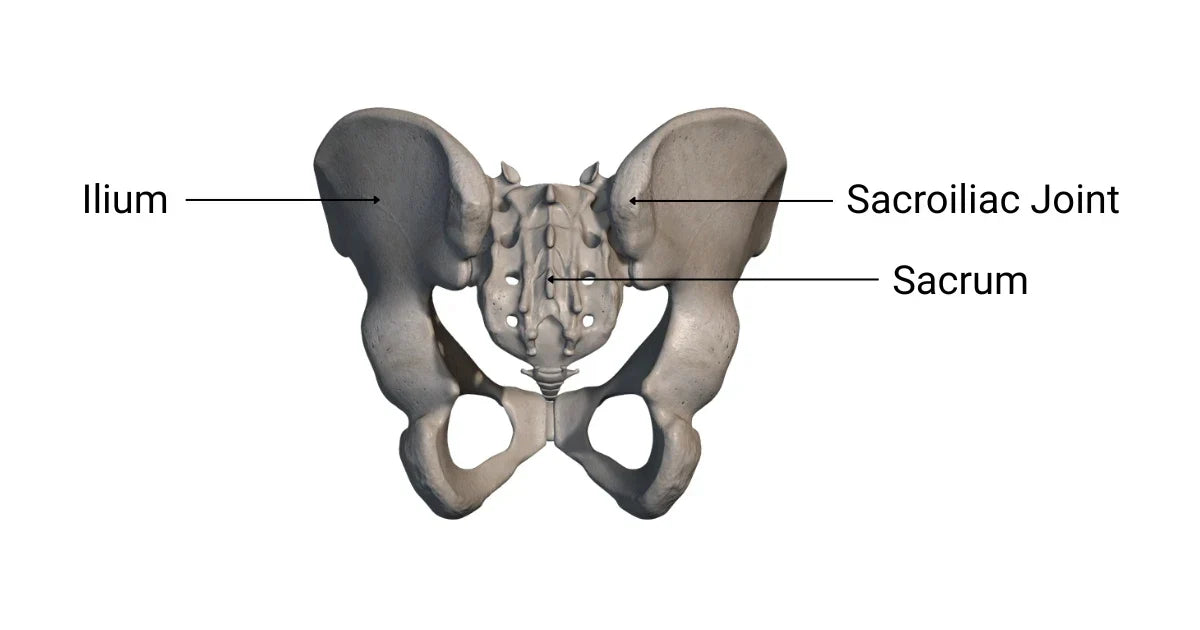
SI joint pain arises when the sacroiliac joint, the connection between the sacrum and the ilium of the pelvis, becomes inflamed, compressed, or unstable. You can locate it by feel: it sits just below the two dimples near the triangle bone (sacrum) at the bottom of your spine. In the vast majority of cases, the root cause is not structural damage to the joint itself. It is chronic tightness or dysfunction in the muscles surrounding the joint, which pull the pelvis out of its optimal alignment and create undue stress on the SI joint. Standard approaches, like joint manipulations, injections, or core and glute strengthening, can provide real relief. However, when this underlying muscle tension is the driver, the results are often short-term.
How does the SI joint work?
Unlike most joints, the SI joint is designed for stability rather than movement. It has only a few millimetres of motion in any direction, but that small amount is essential. With every step, sit-down, or shift of weight, it absorbs and transfers the load back and forth between the entire upper body and the pelvis and into the legs. Because of this central role, SI joint dysfunction often shows up not just locally but throughout the chain: as hip pain, lower back pain, or even knee and ankle complaints on the same side.
The joint is held in place by some of the strongest ligaments in the body, but those ligaments rely on the surrounding muscles to share the load. When the muscles are balanced and at rest, the joint functions well. When they are not, that stress falls on the ligaments and joint instead, and pain often follows.
Which muscles cause SI joint pain?
The SI joint depends on three key muscle groups to distribute load and maintain stability.
- Deep hip flexors (iliacus and psoas): Control the tilt of the pelvis. When chronically tight, particularly on one side, they pull the ilium into anterior rotation, concentrating load asymmetrically on the SI joint and straining the surrounding ligaments.
- Gluteal group (gluteus maximus and gluteus medius): Actively compress and stabilize the SI joint during movement. When these muscles are weak or inhibited, the joint loses that dynamic stability and the surrounding ligaments absorb the load instead, leading to pain and inflammation.
- Deep hip rotators (piriformis): Connect to the sacrum, immediately adjacent to the SI joint, and create external rotation of the hip. When tight, they affect how the sacrum moves relative to the ilium, adding rotational stress through the SI joint with every step.
Chronic tension in any of these groups alters how load is distributed through the joint, contributing to pain and dysfunction. Addressing tension across all three is essential for lasting relief, but of these, the iliacus is most commonly the primary driver and the most frequently overlooked.
How does the iliacus muscle cause SI joint pain?
When the iliacus is chronically contracted or tense, common in anyone who sits for extended periods or with pelvic instability, it pulls the ilium into anterior rotation, tilting the pelvis forward on the affected side and creating uneven load across the SI joint. But its impact doesn't stop there. A tight iliacus also drives compensatory tightness in the piriformis, which has to work harder to manage the rotational stress a misaligned pelvis creates. At the same time, iliacus tension inhibits the gluteal muscles through reciprocal inhibition, making it difficult for them to activate and do their stabilizing job. The result is a cascade: what begins as tension in a single muscle can quietly drive pain across an entire region.
LEARN MORE: What is the Iliacus Muscle?
Why is SI joint pain hard to diagnose and treat?
SI joint pain is difficult to diagnose because its symptoms mimic other conditions. It can present as lower back pain, buttock pain, groin pain, or leg pain that resembles sciatica. Imaging rarely helps: X-rays and MRI scans often appear normal even when pain is present, leaving many patients told that their pain has no clear cause.
Even when the SI joint is correctly identified as the source of pain, standard treatments tend to focus on the joint itself, through manipulation, injections, or anti-inflammatory medication, but without addressing the muscular tension driving the problem. Relief may follow, but without releasing the underlying muscle tension, the joint is pulled back into the same dysfunctional state and pain often returns.
This is why understanding the root cause matters as much as the diagnosis itself.
As a physical therapist of over 25 years, I saw this pattern repeatedly in SI joint patients who had limited success with other approaches. By releasing the iliacus directly with my hands, I was able to help many of them achieve longer-lasting relief and meaningful improvement in their SI joint symptoms. I designed the Hip Hook™ (Mark®) so that people could access and release their own iliacus at home, without needing a practitioner every time.

Can the iliacus be released with stretching or standard tools?
No, the iliacus runs along the inner bowl of the pelvis, making it one of the few muscles in the body that cannot be adequately reached by a foam roller, a massage gun, or stretching techniques.
Releasing the iliacus requires sustained, direct pressure applied to the inside of the pelvic bowl. This can be achieved by seeing a skilled practitioner who performs manual iliacus release, or by using a specialized tool designed to curve around the pelvic bone and access the muscle directly, such as the Hip Hook, which was designed specifically for this purpose.
What is the best approach for SI joint pain?
Effective management of SI joint pain addresses the muscular drivers of joint dysfunction rather than the joint in isolation. The approach that produces the most durable results follows a 3-step framework:
-
Release
- Release the iliacus, as tension in this muscle is the primary driver of anterior pelvic rotation and uneven load across the SI joint
- Release the piriformis to reduce rotational stress through the joint; done after the iliacus, since iliacus tension drives compensatory tightness in the piriformis
-
Realign
- Hip mobility work to restore range of motion in the hip flexor, glute, and deep hip rotator complex and reduce muscle imbalances and rotational stress through the pelvis
- Pelvic mobility work to encourage a more neutral pelvis position following muscle release
- Realignment exercises or adjustments to help restore ideal alignment after the muscles that have been tugging on the joints are released.
-
Reactivate
- Glute activation to restore posterior compression and stabilization of the SI joint; this is most effective after release, since iliacus tension creates reciprocal inhibition that makes it difficult for the glutes to fire properly
- Core activation to rebuild stability around the pelvis and prevent the pattern from returning
- Load management and inflammation management support this process. Reducing activities that compress the joint during the acute phase, and using tools like ice to calm the area once the root cause is being addressed.
NEXT STEP: See the 6-step routine I recommend for SI joint pain
If you haven't been assessed yet, or if you've been working on your SI joint pain without seeing meaningful results, a hands-on evaluation from a physical therapist is always a worthwhile step. A skilled PT can identify the specific muscles driving your dysfunction and guide you through a targeted release and rehabilitation plan.
Frequently asked questions
What are the symptoms of SI joint pain?
SI joint pain typically presents as a dull or sharp ache on one side of the lower back, just below the waist near the dimples of the lower back. Pain can radiate into the buttock, groin, or posterior thigh and is often mistaken for lower back pain or sciatica. Symptoms tend to worsen with prolonged sitting, standing, or activities that load one leg at a time, such as walking, climbing stairs, or running. Transitioning from sitting to standing and rolling over in bed are also common aggravating movements. Because the pain pattern is inconsistent and mimics other conditions, SI joint dysfunction is frequently misdiagnosed.
Does SI joint pain show on MRI?
Not always. MRI may show joint space changes, sacroiliitis, or ligament stress in more advanced cases, but many patients with clinically significant SI joint dysfunction have completely normal imaging. A clinical diagnosis based on hands-on physical examination from a physical therapist is often far more informative than imaging alone.
Is SI joint pain the same as sciatica?
No, but they can occur together. Sciatica describes pain traveling along the sciatic nerve from the buttock down the leg. SI joint pain originates from the sacroiliac joint and surrounding musculature. The overlap happens because the piriformis attaches directly to the sacrum adjacent to the SI joint, meaning piriformis tightness can irritate the SI joint and compress the sciatic nerve at the same time. Chronic tension in the iliacus is often the upstream driver of both, as it alters pelvic alignment and increases load on the SI joint and the piriformis simultaneously.
Can iliacus tightness cause SI joint pain?
Yes, and it is one of the most overlooked mechanisms behind SI joint pain. The iliacus attaches directly to the inner surface of the ilium and, when chronically tight, pulls the pelvis into anterior rotation on the affected side. This creates uneven load across the SI joint, strains the surrounding ligaments, and drives compensatory tightness in the piriformis. The result is a cycle of joint irritation that persists as long as the iliacus tension goes unaddressed, which is why releasing the iliacus is an important first step in an effective SI joint rehabilitation plan.
What causes SI joint pain to flare up?
The most common triggers are activities and habits that increase tension in the iliacus and surrounding muscles. Prolonged sitting is one of the most significant. When the iliacus is held in a shortened position for extended periods, it tightens and increases strain on the SI joint. Other common triggers include running, deep lunges, yoga poses that push the hips into end range, pelvic instability with injury or pregnancy, and sleeping on the affected side. Stress is also a notable driver. The iliacus is one of the primary muscles activated during the body's fight-or-flight response, meaning emotional stress can directly increase muscle tension and aggravate symptoms.
How long does SI joint pain last?
SI joint pain can persist for several months when the underlying muscular tension remains unaddressed. Without releasing the iliacus and the other muscular drivers of dysfunction, the pattern tends to be cyclical; symptoms improve for a period and then return. Addressing the root cause through targeted muscle release, mobility work, and strengthening typically produces more durable results than injection therapy or manipulation alone, because those approaches don't resolve what is irritating the joint in the first place.
What is the best sleeping position for SI joint pain?
Side sleeping with a pillow between the knees or back sleeping with a pillow under the knees is generally most comfortable, as it keeps the pelvis in a more neutral position, puts the iliacus on slack, and reduces compression on the SI joint. Sleeping directly on the affected side can increase joint compression and worsen symptoms.
References
- Fortin JD, Dwyer AP, West S, Pier J. Sacroiliac joint: pain referral maps upon applying a new injection/arthrography technique. Spine. 1994;19(13):1475-1482.
- Vleeming A, Schuenke MD, Masi AT, Carreiro JE, Danneels L, Willard FH. The sacroiliac joint: an overview of its anatomy, function and potential clinical implications. Journal of Anatomy. 2012;221(6):537-567.
- Simopoulos TT, Manchikanti L, Singh V, et al. A systematic evaluation and critical appraisal of the scientific evidence of sacroiliac joint interventions. Pain Physician. 2012;15(3):E247-E278.
- Sadiq A, Khalid Z, Kiran T, Hassan W. Additional effects of piriformis stretch in the management of sacroiliac joint dysfunction: A randomized controlled trial. Journal of Bodywork and Movement Therapies. 2025;44:149-154.


If you’ve tried PT, massage, stretching, and the pain keeps coming back, the problem is likely not where you’re feeli...
- HSA/FSA eligible
- 60-day returns
- Free shipping
If you’ve tried PT, massage, stretching, and the pain keeps coming back, the problem is likely no...