


What Does Sitting All Day Do to Your Body?
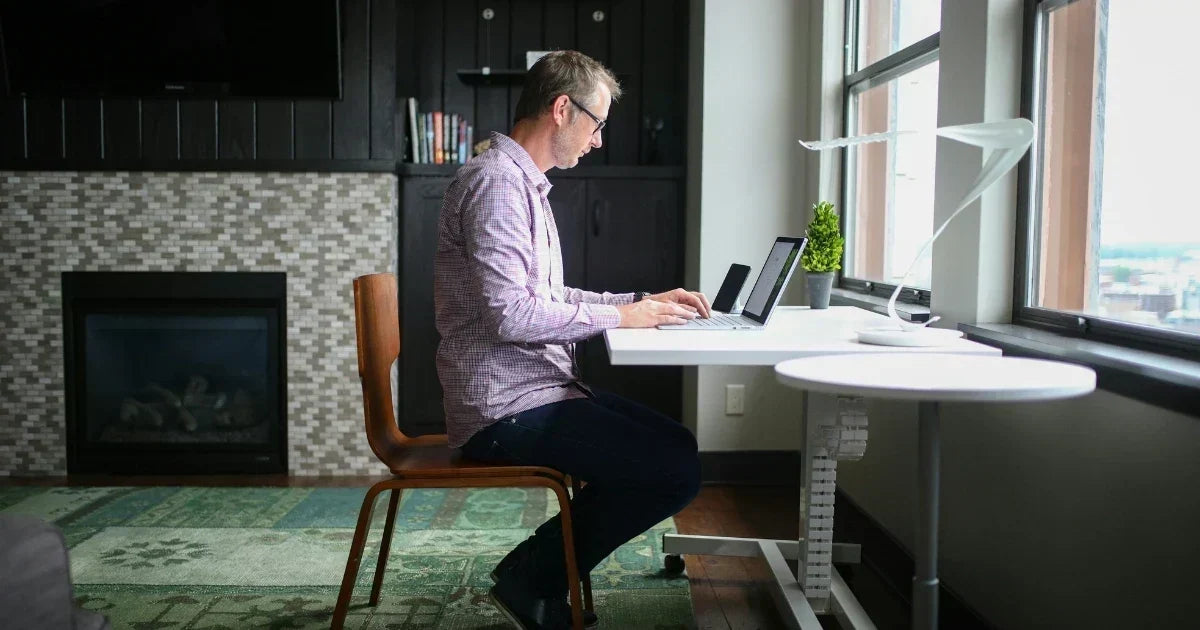
If you sit at a desk most of the day, the pain building through your back, hips, neck, and shoulders by evening has a specific origin, and it usually isn't just where it hurts.
Sitting collapses your body into a sustained position that shortens the muscles at the front of your hips, rounds your upper back, and pushes your head forward of your spine. Each of those changes loads a different set of muscles, and each of those muscles pulls on something else. The result is a chain reaction running through your lower and upper body that explains why desk workers so often end up with pain in multiple places at once rather than just one.
This article traces both chains, link by link, and explains what to focus on that will actually move the needle.
How Sitting Impacts the Lower Body
Sitting doesn't cause problems randomly. It holds your body in one position long enough that your muscles adapt to it, and that adaptation follows a specific sequence. It starts at the hip flexors and works its way through your pelvis, your lower back, and the muscles that stabilize both.
Why does sitting tighten your hip flexors?
Sitting holds your hip flexors in a shortened position for hours at a time, and muscles adapt to the positions they're held in most. The longer they stay shortened, the more they adapt to that length. Additionally, the iliacus muscle works overtime to hold you upright and develops tension in response to overuse. That's often the reason: when you stand up and try to extend your hip fully, the range that should be effortless actually starts to feel restricted.
The two key muscles here are the iliacus and the psoas. The iliacus lines the inside of your pelvic bone and connects your pelvis to your thigh; the psoas runs alongside your lumbar vertebrae and attaches to your lower spine before meeting the iliacus at the same point on your thigh. Both shorten during prolonged sitting, with the iliacus pulling your pelvis forward, and the psoas pulling directly on your lower back.
Research on prolonged sitting has linked extended time in a seated position to measurable reductions in hip extension, exactly the movement sitting restricts all day.1 Leaning forward at your desk makes this worse by shortening the angle between your torso and thighs even further.2

Why does sitting cause lower back pain?
Sitting can cause lower back pain because it shortens two key hip flexors, the iliacus and psoas, in ways that load your lower back from two different directions. When the iliacus shortens and becomes tight, it pulls the front of your pelvis downward and forward into a position called anterior pelvic tilt, which forces your lower back to arch more to keep you upright. The psoas adds another layer. Because it attaches along your lumbar vertebrae, a tight and short psoas pulls on the lower back directly, compounding the compression the pelvic tilt is already creating from below.
Research has found that iliopsoas shortening is associated with increased lumbar lordosis, meaning the natural curve of your lower back becomes more pronounced.3 That increased curve adds compressive load specifically at L4-L5 and L5-S1, which are the two lowest disc levels in your spine and the ones most commonly involved in spinal arthritis and disc-related back pain.4
The quadratus lumborum (QL), a muscle running along the side of your lumbar spine that connects your lower ribs to your pelvis, often gets pulled into the same pattern. Hip flexor tightness tends to be worse on one side, so the pelvic tilt is rarely perfectly even. When the imbalance is asymmetrical, the QL on the tighter side shortens while the other is overstretched, adding a lateral component to what is already a compressive pattern. That asymmetry also creates uneven stress at the SI joint, the junction where your pelvis meets your spine, which is part of why sitting-related back pain often shows up as a deep, one-sided ache rather than central lower back pain.
That forward tilt creates an imbalance that sets off the next problem, impacting the muscles that are supposed to counterbalance it from behind.
Does sitting cause glute pain or sciatica?
Sitting can contribute to both, and they're connected by the same underlying mechanism. When the iliacus holds chronic tension, it neurologically inhibits its opposing muscle group through a process called reciprocal inhibition. In practice, this means your glutes stop firing properly, regardless of how much you exercise them. One side is often more affected than the other, which is why people with long-term desk jobs frequently notice one glute feels weaker or less engaged than the other.
The problem this creates goes beyond glute strength. Your glutes are the primary stabilizers of the pelvis from behind. When they're inhibited, there's nothing counterbalancing the forward pull the iliacus is creating from the front. The result is that the pelvic tilt deepens, and the piriformis, a smaller, deeper muscle in the buttock, gets recruited to pick up stabilization work it wasn't designed to handle alone.
A piriformis that's overworking eventually tightens. And because it sits directly next to the sciatic nerve, a tight piriformis can compress it. This is one of the more commonly missed causes of pain running down the leg. The deep buttock ache that so often accompanies lower back pain from sitting is the same pattern expressing itself through a different set of structures.

LEARN MORE: What Is the Sciatic Nerve, and the Three Places It Can Get Pinched
Why do your hamstrings feel tight after sitting?
Your hamstrings feel tight after sitting not because they've shortened, but because your pelvis has tipped forward, which pulls the sit bones, where the hamstrings attach at their upper end, backward and upward. That shifts the hamstrings into a lengthened, taut position. They register as tight not because they've contracted, but because they're being continuously pulled from one end.
This is why stretching them tends to give only temporary relief. The sensation eases briefly, then returns, because the tension isn't coming from the hamstrings themselves. It's coming from the pelvic position they're anchored to. Until that forward tilt is addressed at the source, the hamstrings will keep signaling tension that no amount of stretching fully resolves.
How Sitting Impacts the Upper Body
The forward collapse that tilts your pelvis and loads your lower back doesn't stop there. Sitting also rounds your thoracic spine, which rolls your shoulders forward and lets your head drift in front of your spine. Each of those shifts loads a different set of muscles. Just like the lower body chain, the upper body chain has a starting point that drives everything downstream from it.
Why does sitting cause a tight chest and rounded shoulders?
When your thoracic spine rounds from prolonged sitting, your chest muscles (particularly the pec minor, a small muscle that runs from your ribs to the front part of your shoulder blade on your chest) shorten and tighten to match that position. A tight pec minor pulls your shoulders forward and internally rotates your arms, locking your upper body into the rounded posture that sitting encouraged in the first place. The longer you sit, the more that shortened position becomes the resting default.
This matters beyond posture. Tight pecs pull your shoulders out of their neutral position, which forces the muscles in your neck and upper back to work harder just to keep your head upright. Stretching the pecs can temporarily improve shoulder position, but without releasing the underlying tension first, the shoulders return to their rounded default as soon as the stretch ends. The pec minor is where the upper body tension chain starts, and like the iliacus in the lower body, releasing it first is what makes the downstream work more effective.
Why do your upper traps get tight from sitting?
Your upper trapezius muscles, which run from the base of your skull down to your shoulders, aren't designed to be primary stabilizers. They're meant to assist with neck and shoulder movement, not to hold a forward-drifting head in place for eight hours. But when the pec minor shortens and pulls your shoulders forward, the upper traps get recruited to compensate. For each millimeter the shoulders round or the head moves forward, the upper trap works overtime to stabilize a head that's been pulled out of position, and chronic overwork is what turns them into the knotted, tender tissue most desk workers know well.
What most people don't realize is that chronically tight upper traps don't just cause shoulder and neck tension. They also have a well-documented referral pattern that sends pain into the head. The upper traps commonly refer pain to the temple, the side of the head, and behind the eye, the same locations where most people experience tension headaches. If your headaches tend to build through the day at a desk, the upper traps are often where that pain is actually originating.
This is why upper trap tension from sitting rarely responds well to massage or stretching alone. The traps are tight because they're compensating, and they'll keep compensating until the muscles driving the compensation are addressed first. Releasing the pec minor and the suboccipitals is what allows the upper traps to finally let go.
Why does sitting cause neck pain and headaches?
Deeper still, at the base of your skull, another set of muscles is responding to the same forward head posture. The suboccipitals, a group of small muscles at the junction where your skull meets your neck, are responsible for most of your neck's fine rotational movement, and in a neutral head position they work within their capacity.
For every inch your head moves forward of your spine, the effective load on these muscles increases significantly. Held in that position for hours, they develop concentrated areas of tension that refer pain upward into the skull. This is typically felt as a band of pressure wrapping over the top of the head or a deep ache at the base of the skull, distinct from the temple-focused pattern the upper traps produce.
The suboccipitals are also why neck stiffness from sitting tends to show up most noticeably when you try to rotate your head, rather than just feeling like general soreness. These muscles control the small, precise movements of your upper neck, and when they're loaded with chronic tension, rotation is the first movement to suffer.

How to Reverse the Effects of Sitting
The most effective approach follows the same order as the chain itself: address the muscles that started the pattern before working on the ones compensating for it. Most standard fixes fall short not because they're wrong, but because they work backward from the symptom rather than forward from the cause.
Release, Realign, Reactivate
I recommend people start with what I call the primary core (the hip and pelvis region) before the secondary core (the neck and shoulder region), following the same three-step sequence in each.
Release comes first because chronically tight muscles don't respond to stretching the way most people expect. Stretching moves a muscle through its range, but if the muscle is holding tension at rest, that tension returns as soon as the stretch ends. Sustained, direct pressure held for 90 seconds or more is what triggers the muscle to actually let go. It is a different mechanism entirely, and one that has to happen before the next two steps work most effectively.
Realign comes second. Once the tension is released, stretching, mobility, and alignment work hold better because the muscles aren't pulling the skeleton back out of position the moment you stop. This is when hip flexor stretches, pec stretches, and postural exercises produce real change rather than temporary relief.
Reactivate comes third. The muscles that chronic tension has been inhibiting, like the glutes, the core, and the deep cervical flexors, can't be effectively strengthened while the muscles opposing them are overloaded. Additionally, activating muscle control on an aligned and released body reinforces a better pattern than encouraging a tight and twisted body. After release and realignment, reactivation exercises rebuild the stability that sitting has been gradually eroding.
Start with the Primary Core
The hip and pelvis region is where both chains begin. The iliacus and psoas are the starting point: both sit too deep for foam rolling or standard stretching to reach directly. Additionally, sustained precise pressure is what releases them effectively, not rubbing or stretching. (The Hip Hook is designed to reach the iliacus at the inner pelvic bone; the Orbit works well for the psoas, which sits slightly more accessible.) Once the hip flexors are released, then release the piriformis. It's been overworking to compensate, and releasing it becomes more effective once the hip flexor tension driving that compensation is addressed. Hip flexor and piriformis stretches come next, followed by realignment exercises, then exercises like bridges and clamshells to reactivate the glutes that reciprocal inhibition has been suppressing.
Then the Secondary Core
The neck and shoulders follow the same sequence, starting with the pec minor. Tight pecs are what initiated the upper body chain, pulling the shoulders forward and forcing everything above them to compensate. Releasing the pec minor first takes that upstream load off before you address the upper traps and the smaller, more sensitive muscles of the neck. (The Range targets the pec minor, the suboccipitals at the base of the skull, and the upper traps, the three muscles driving the upper body pattern, with sustained pressure at the right depth for each.) Pec and shoulder stretches follow the releases, followed by corrective exercises like chin tucks to reactivate the deep cervical flexors that forward head position has been inhibiting.
NEXT STEP: See the Full-Body Tension Release Routine
Frequently Asked Questions
How many hours of sitting is considered bad for you?
There is no single threshold, but research has found measurable reductions in hip extension and increases in anterior pelvic tilt in people sitting for the kind of hours typical of a standard desk job. The effect builds gradually with total daily sitting time rather than switching on at a specific hour mark, which means how much you accumulate across the whole day matters more than any single stretch of sitting. Changing positions every 30-60 minutes does help reduce the effects of sitting.
Why do I feel stiff when I first stand up after sitting?
The stiffness you feel when you first stand is your hip flexors and hip joints resisting elongation and movement. After holding a shortened position for an extended period, the iliacus and psoas resist the sudden demand to lengthen, which is exactly what standing and walking require. The stiffness typically eases within a few minutes as the muscles are gradually loaded back into a lengthened position, but it returns each time you sit for an extended period because the underlying tension hasn't changed.
Why does my back hurt more the next day, not while I'm actually sitting?
Your back hurts more the next day because the seated position itself was partially masking the problem as it built. The changes from sitting, such as shortened hip flexors, a forward-tilted pelvis, and increased disc pressure, accumulate throughout the day, but the seated position holds your body in a way that shortens them so they don't feel strained. Once you stand up, move around, or lie down, those shortened and tense muscles attempt to lengthen, and the accumulated tension becomes fully apparent. By the next morning, muscles that spent the day adapting to a shortened position have stiffened further overnight, which is why the pain is often worse in the first few minutes of movement after waking.
Why does my neck hurt after sitting at a desk?
Neck pain from sitting is usually about where your head ends up relative to your spine. Prolonged sitting rounds the thoracic spine and rolls the shoulders forward, which lets the head drift in front of its neutral position. Additionally, much of our time at desks is looking down or leaning forward, further stressing the muscles in the neck. For every inch the head moves forward, the load on the muscles at the base of the skull and upper back increases significantly. Held in that position for hours, muscles like the suboccipitals and upper traps accumulate tension that shows up as stiffness, soreness, or headaches.
Is stretching enough to undo the effects of sitting?
Stretching helps, but on its own it usually isn't enough. Stretching moves a muscle through its range of motion, but if the muscle is holding tension at rest, that tension returns as soon as the stretch ends. Releasing the muscle tension directly, through sustained pressure held for 90 seconds, helps the muscle let go. Stretching after release produces a longer-lasting change because, with the tension removed, the muscle can achieve its full range of motion.
Can a standing desk fix the problems caused by sitting?
A standing desk helps by reducing total sitting time, but it doesn't release tension that has already built up in your hip flexors. If your iliacus and psoas have adapted to a shortened length, standing more doesn't change that. In fact, standing with tense hip flexors often feels like a hip or lower back ache. A standing desk works best as part of a routine that includes release work, not as a standalone fix.
Can the effects of long-term sitting be reversed?
In most cases, yes. Muscle shortening from sitting is a mechanical adaptation, not a permanent change. It can be addressed by releasing the muscle tension that's built up, restoring the movement patterns that sitting restricted, and reactivating the muscles that chronic tension has been suppressing. It typically takes consistent effort rather than a single session to undo months or years of adaptation, but the body has an amazing capacity to adapt.
References
- Boukabache A, Preece SJ, Brookes N. Prolonged sitting and physical inactivity are associated with limited hip extension: a cross-sectional study. Musculoskeletal Science and Practice. 2020;51:102282. https://doi.org/10.1016/j.msksp.2020.102282
- Vijay Selvan N, et al. Influence of prolonged sitting posture in the occurrence of lower crossed syndrome in college students. Acta Scientific Orthopaedics. 2023;6(11):02–08. https://actascientific.com/ASOR/pdf/ASOR-06-0843.pdf
- Ludwig O, Dindorf C, Kelm S, Kelm J, Fröhlich M. Muscular strategies for correcting the pelvic position to improve posture: an exploratory study. Journal of Functional Morphology and Kinesiology. 2024;9(1):25. https://doi.org/10.3390/jfmk9010025
- Comparative effects of plank exercises and muscle energy technique on lower crossed syndrome. Journal of Health, Wellness and Community Research. https://jhwcr.com/index.php/jhwcr/article/view/536
- Preece SJ, Tan Y, Alghamdi T, Arnall F. Comparison of pelvic tilt before and after hip flexor stretching in healthy adults. Journal of Manipulative and Physiological Therapeutics. 2021;44(4):289–294. https://doi.org/10.1016/j.jmpt.2020.09.006
- Brookbush Institute. Iliacus muscle: function, dysfunction, and rehabilitation. https://brookbushinstitute.com


If you're dealing with pain in more than one place; if you have chronic low back pain, sciatica, SI joint pain, hip p...
- HSA/FSA eligible
- 60-day returns
- Free shipping
If you're dealing with pain in more than one place; if you have chronic low back pain, sciatica, ...