


What Causes Headaches and Migraines? How Neck Tension Is Often the Missing Piece
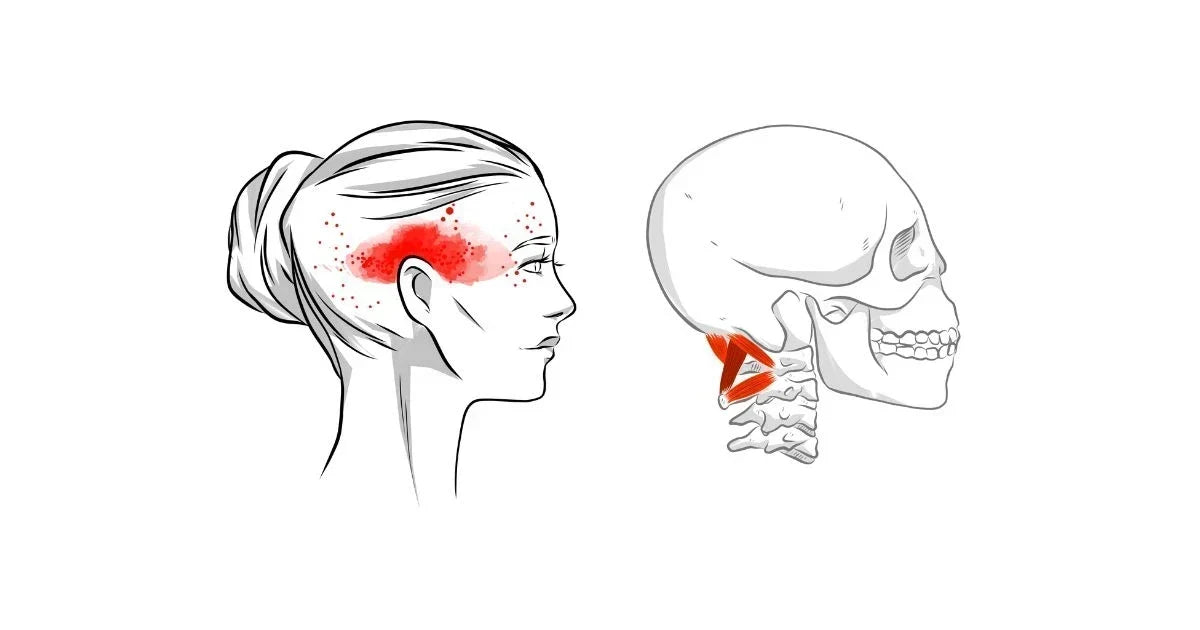
Headaches and migraines affect nearly 90% of people at some point in their lives, and for the many who deal with them chronically, relief tends to be temporary at best. The dull ache behind the eyes, the throbbing on one side of the head, the pressure that starts at the base of the skull and radiates forward: these patterns feel neurological.
But in a meaningful share of cases, the real driver is muscular: chronic tension in the neck muscles, particularly the suboccipitals at the base of the skull, that refer pain along the exact nerve pathways producing classic headache and migraine symptoms. Because this pattern mimics vascular migraine so closely, the muscular source often goes unaddressed. Medication may quiet the pain temporarily, but if neck muscle tension is driving nerve irritation, the pattern keeps returning.
How does neck muscle tension cause headaches?
Most people think of headaches as a head problem. But the structures most responsible for chronic headache pain are often located in the neck. Muscles in the upper cervical region can develop trigger points: localized areas of chronic tension that, when active, refer pain away from where they actually are. In the case of neck muscles, that referred pain travels directly into the head: behind the eyes, across the forehead, and along the temples.
This happens because the upper cervical nerves (C1–C3) share pathways with the trigeminal nerve, which processes sensation from the face and head. When muscles in the neck compress or irritate these nerve pathways, the brain interprets the pain as coming from the head, even though the source is in the neck.1
READ MORE: How Does Forward Head Posture Affect the Cervical Spine?
Which neck muscles are most commonly responsible for headaches?
Several muscles in the neck and upper back are consistently implicated in headache pain. The most common are:
- Suboccipitals: Four small muscles at the base of the skull that refer pain to the forehead, temples, and behind the eyes. They are the most frequent driver of chronic headache from muscle tension, and the most commonly overlooked.
- Upper trapezius: Runs from the base of the skull to the shoulder. Trigger points here contribute to the tight, banding sensation many people describe across the back of the head and neck, and are strongly associated with tension-type headache.2
- Sternocleidomastoid (SCM): Runs along the side of the neck. Trigger points in this muscle refer pain to the forehead, ear, and behind the eye: a pattern frequently mistaken for migraine.2
- Scalenes and levator scapulae: Deeper neck muscles that add load to the upper cervical region and can sustain or worsen the tension patterns above.

Why are the suboccipitals the most overlooked driver of headache pain?
Of all the muscles involved in headache, the suboccipitals may be the most significant, and the most frequently missed. Active trigger points in the suboccipital muscles have been directly associated with chronic tension-type headache, with greater trigger point activity correlating with higher headache frequency and intensity.3
What makes them easy to overlook is that their tension rarely shows up as neck stiffness. The suboccipitals sit at the deepest layer of the neck, directly against the base of the skull, so their effects are felt in the head (behind the eyes, across the forehead, at the temples), not in the neck where the problem actually originates.
They also have a direct anatomical connection to the membrane surrounding the brain and spinal cord, which is why their tension can produce such wide-ranging head symptoms.1 That connection is worth understanding in more depth if suboccipital headaches are something you deal with regularly.
READ MORE: Tightness at the Base of the Skull? Massage These Muscles
Why does neck tension so often go undiagnosed as the cause of headaches?
Cervicogenic headache and migraine are genuinely difficult to tell apart. Both can present with unilateral pain, a throbbing quality, and sensitivity to light and sound. This means that a physical examination alone often cannot reliably distinguish them.4 Imaging is rarely more helpful, as structural changes in the neck are common findings in people with no headache symptoms at all.
Migraines have historically been explained through a vascular lens, which is part of why a muscular driver in the neck is so often overlooked. When symptoms match the migraine pattern, that tends to be where the diagnosis lands, and where treatment stays.
Even when a cervical contribution is suspected, treatment tends to focus on medication or nerve blocks rather than the underlying muscle tension driving the nerve irritation. A nerve block can interrupt the pain signal, but if the suboccipital and cervical muscles remain chronically tight, the trigger points reload and the pattern returns. A review of patients with longstanding migraine diagnoses found that several had gone years without meaningful relief from migraine-specific therapies, only to improve significantly once the cervical source of their pain was identified and treated directly.5
Cervicogenic headache remains one of the most underdiagnosed causes of chronic head pain, not because it is rare, but because its symptoms look so much like what most people have already been told they have.
How can you tell if muscle tension is contributing to your headaches?
The simplest way to check is to press firmly with your fingertips along the base of your skull, just above where your neck meets your head, moving from behind your ears toward the center. Tender or tight spots that reproduce a familiar headache pattern, especially if pressing on one side recreates pain behind the eye or across the forehead, are a strong indicator that suboccipital tension is a factor.
You can also check the upper trapezius by pressing along the top of your shoulder toward the base of your neck, and the SCM by gently pinching the muscle that runs diagonally along the front of your neck. Tenderness in any of these areas that echoes your usual headache pattern suggests the neck muscles are involved.
If any of this feels familiar, the next question is how to actually address it.
Why don't stretching and standard tools resolve neck tension headaches?
The instinct to stretch a tight neck or use a foam roller makes sense, but for trigger points in the suboccipital and cervical muscles, it often backfires. Rubbing, vibration, and stretching can activate and aggravate trigger points rather than release them, which is why many people notice their headaches worsen after a massage or an intense stretch session. The mechanism that releases a trigger point is sustained pressure, not movement across it.
Standard tools create a second problem: they can't reach the muscles that matter most. A foam roller or massage ball is too broad to isolate the suboccipitals, which sit in a narrow band directly against the base of the skull beneath larger superficial muscles. The pressure lands on the upper trapezius or the skull itself instead.
Releasing the suboccipitals requires precise, sustained pressure along the base of the skull. This is the kind delivered by a skilled practitioner, or by a tool specifically shaped to target that region, like the Range.
LEARN MORE: Discover the Range

What is the best approach for relieving headaches and migraines?
The approach that produces the most durable results addresses the muscular drivers of nerve irritation rather than treating head pain in isolation. It follows three steps.
-
Release
- Release the suboccipitals first, since tension here directly irritates the occipital nerves.
- Follow with the upper trapezius and SCM to reduce compounding tension around the base of the skull and side of the neck.
- Aim to do this two to three times per week, and importantly, do it when you are not in a headache. Once a headache is active, the trigger points are already firing and working on them is often too late and can make symptoms worse.
-
Realign
- Cervical mobility work to restore rotation and extension, both commonly reduced in cervicogenic headache.
- Postural work to address forward head position, which increases resting load on the suboccipitals throughout the day.
-
Reactivate
- Deep neck flexor activation to help the neck share load more evenly and reduce ongoing tension on the suboccipitals.
- This works best after release, since chronically tight suboccipitals can inhibit these stabilizing muscles from firing properly.
Throughout all three steps, managing load matters. Reducing prolonged forward head postures, extended phone or screen use especially, gives released tissue the space to settle and reduces the rate at which trigger points reload.
NEXT STEP: See the 6-step routine I recommend for headaches and neck pain
If you have not been evaluated yet, or if you have been managing recurring headaches without meaningful relief, a hands-on evaluation from a physical therapist is always a worthwhile step, particularly if your headaches began after an injury or whiplash. A skilled PT can identify the specific muscles driving your dysfunction and guide you through a targeted release and rehabilitation plan.
Frequently asked questions
Can muscle tension cause migraines?
Yes. Research shows that chronic tightness in the suboccipital muscles, upper trapezius, and sternocleidomastoid can produce headache pain that is clinically difficult to distinguish from migraine on symptoms alone. This does not mean every migraine has a muscular cause, but it does mean muscle tension should be ruled in or out before settling on a purely vascular or neurological explanation, particularly when standard migraine treatments haven't provided lasting relief.
Are migraines vascular or muscular?
Both may be involved, but the relationship is more complex than the traditional vascular explanation suggests. Vascular changes in the brain do occur during migraine, but emerging evidence and clinical experience indicate that trigger points in the neck and suboccipital muscles often play a central role in initiating that process. This helps explain why medication can quiet a migraine temporarily without preventing the next one: it addresses the vascular response but not the muscular tension that may be driving it. For many people with recurring migraines, addressing the neck muscles produces more durable results than managing the vascular component alone.
What are the symptoms of a cervicogenic headache?
Cervicogenic headache typically presents as one-sided, non-throbbing pain that starts at the base of the skull or neck and radiates toward the forehead, temple, or behind the eye. It is often aggravated by neck movement, sustained postures, or pressure on the upper neck, and may come with reduced neck range of motion. A key indicator is that pressing on the upper neck or base of the skull reproduces the headache pattern. Because it can also feel throbbing and be accompanied by light sensitivity, it is frequently mistaken for migraine.
Does a cervicogenic headache show up on imaging?
Not reliably. MRI or X-ray may show mild disc or joint changes in the neck, but these are common findings in people without any headache symptoms, which means a clean scan doesn't rule out a cervical cause. A clinical exam that checks suboccipital tenderness, neck range of motion, and whether pressing on the upper neck reproduces the headache is generally more useful than imaging for identifying a cervical or muscular source.
What triggers headaches caused by muscle tension?
Prolonged forward head posture is one of the most common triggers, since it increases the resting load on the suboccipital muscles throughout the day. Other common triggers include extended screen or phone use, stress (which increases baseline muscle tension throughout the neck and shoulders), poor sleep positions that keep the neck rotated or flexed for hours, and any activity requiring sustained looking down or up, such as reading, driving, or looking at a phone for extended periods. Holding any static neck position for too long, even a neutral one, can activate trigger points over time. Changing position every 15 to 30 minutes is one of the most effective ways to reduce trigger point buildup throughout the day.
How long do tension headaches last?
Muscle tension headaches can persist for months or become a recurring pattern when the underlying suboccipital tightness goes unaddressed. Without releasing the muscles contributing to nerve irritation, symptoms tend to be cyclical, easing for a period before returning with the next stretch of poor posture or stress. Addressing the muscular driver through release, mobility work, and postural correction typically produces more durable results than medication alone, because it targets what keeps reloading the pattern rather than quieting the symptoms after the fact.
Should I work on my neck muscles during an active headache?
Generally not. Once a headache is active, the trigger points are already firing and a biochemical cascade is underway that takes time to resolve on its own. Trying to release the muscles at that point is often too late to stop the headache, and in some cases can make symptoms worse. The most effective time to work on the suboccipitals, upper trapezius, and SCM is when you are feeling well, not during a flare-up. Consistent release two to three times per week, done preventatively, is what reduces the frequency and intensity of headaches over time rather than trying to intervene once one has already started.
What is the best sleeping position for headaches from neck tension?
Back sleeping with a pillow that supports the natural curve of your neck, without pushing your chin toward your chest or tilting your head to one side, keeps the suboccipital muscles in their most relaxed position overnight. Side sleeping can work well with the right pillow height, as long as your head stays level with your spine rather than dropping or tilting. Stomach sleeping is usually the most aggravating position since it rotates the neck for hours at a time, loading the suboccipitals and SCM throughout the night.
Is it safe to use a pressure tool at the base of the skull if I have had a whiplash injury or concussion?
Possibly, but check with your physical therapist or physician first. Suboccipital release can be a helpful part of a broader recovery plan for whiplash and post-concussion headaches, but timing and approach need to be guided by your specific injury and stage of recovery. If you are experiencing any neurological symptoms alongside your headaches, such as dizziness, visual changes, or numbness, get cleared by a provider before starting any new tool or technique at the base of the skull.
References
- Bogduk N. Cervicogenic headache: anatomic basis and pathophysiologic mechanisms. Curr Pain Headache Rep. 2001;5(4):382-386. DOI: 10.1007/s11916-001-0029-7
- Fernández-de-las-Peñas C, Alonso-Blanco C, Cuadrado ML, Gerwin RD, Pareja JA. Myofascial trigger points and their relationship to headache clinical parameters in chronic tension-type headache. Headache. 2006;46(8):1264-1272. DOI: 10.1111/j.1526-4610.2006.00440.x
- Fernández-de-las-Peñas C, et al. Trigger points in the suboccipital muscles and forward head posture in tension-type headache. Headache. 2006;46(3):454-460. DOI: 10.1111/j.1526-4610.2006.00288.x
- Anarte-Lazo E, Carvalho GF, Schwarz A, Luedtke K, Falla D. Differentiating migraine, cervicogenic headache and asymptomatic individuals based on physical examination findings: a systematic review and meta-analysis. BMC Musculoskelet Disord. 2021;22:755. DOI: 10.1186/s12891-021-04595-w
- Yi X, Cook AJ, Hamill-Ruth RJ, Rowlingson JC. Cervicogenic headache in patients with presumed migraine: missed diagnosis or misdiagnosis? J Pain. 2005;6(10):700-703. DOI: 10.1016/j.jpain.2005.04.005


Whether you spend hours at a screen, drive frequently, carry a bag or a child on one side, or just hold stress in you...
- HSA/FSA eligible
- 60-day returns
- Free shipping
Whether you spend hours at a screen, drive frequently, carry a bag or a child on one side, or jus...